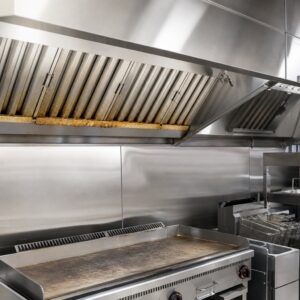
Industrial kitchens and food processing facilities operate at a scale most restaurants never see – multi-line production, round-the-clock shifts, and exhaust systems that move far more grease-laden air than a typical commercial kitchen. That volume creates a compliance and fire-risk profile that standard restaurant cleaning schedules simply weren’t designed for. Industrial kitchen cleaning requires a different cadence, different equipment, and a different documentation standard – one built around continuous production rather than a single dinner service.
For plant managers, food safety coordinators, and facilities directors across the GTA and Southern Ontario, getting industrial kitchen cleaning wrong isn’t just a fire code violation – it’s a production shutdown risk, a food safety audit failure, and a WSIB liability. This guide breaks down what makes industrial and food processing kitchens different, the regulatory framework that governs them, and the cleaning program that keeps high-volume facilities compliant and running.
What Makes Industrial Kitchen Cleaning Different
A standard restaurant kitchen runs one or two exhaust hoods for a handful of cooking lines, typically for 8–14 hours a day. An industrial kitchen or food processing facility – think commissary kitchens, institutional food production plants, catering production facilities, or large-scale prepared-food manufacturers – can run multiple exhaust systems simultaneously across 16–24 hour production cycles, often seven days a week.
Higher Grease and Airflow Volume
More cooking lines running longer hours means grease accumulates faster and in greater volume. NFPA 96 – the standard that governs ventilation control and fire protection for commercial cooking operations – doesn’t set a different bar for industrial facilities, but it does tie inspection frequency directly to volume: “high-volume” cooking operations (which most industrial and 24-hour facilities qualify as) require exhaust system inspection as frequently as monthly, compared to quarterly or semi-annually for lower-volume operations. A facility running three shifts a day is, by NFPA’s own volume-based classification, almost always in the high-volume tier.
Multiple Systems, Multiple Points of Failure
Where a restaurant might have one hood and one exhaust run, an industrial facility often has several independent systems serving different production lines, each with its own ductwork, fans, and fire suppression coverage. Each system needs to be tracked, inspected, and cleaned on its own schedule – a single missed system among ten is still a code violation and a fire risk, even if the other nine are spotless.
Production Downtime Is the Real Cost
In a restaurant, a delayed cleaning might mean a slightly greasier hood for another week. In a food processing facility, unplanned downtime for an emergency cleaning – triggered by a failed fire marshal inspection or an insurance audit – can halt an entire production line and cascade into missed delivery commitments. Scheduled, documented commercial kitchen cleaning planned around production windows avoids that risk entirely.
The Regulatory Framework for Industrial Facilities
Industrial kitchens and food processing plants in Ontario sit at the intersection of several overlapping compliance regimes, and facility managers need to satisfy all of them – not just fire code.
NFPA 96 and the Ontario Fire Code
NFPA 96 remains the technical standard referenced by the Ontario Fire Code for ventilation control and fire protection of commercial cooking operations, industrial food production included. It sets requirements for hood and duct construction, fire suppression system design, and – critically – inspection and cleaning frequency based on volume. High-volume operations (most industrial facilities) fall into the most frequent inspection tier, and cleaning to bare metal is required whenever inspection reveals grease buildup, regardless of the calendar schedule.
Food Safety Program Requirements
Facilities operating under HACCP-based food safety programs, GFSI-recognized certifications (SQF, BRCGS, FSSC 22000), or CFIA oversight for federally registered plants have their own sanitation documentation requirements layered on top of fire code. Exhaust and hood cleanliness is frequently an audit point in these programs because grease accumulation is a contamination and pest-attraction risk, not just a fire hazard. Auditors expect to see cleaning logs, service invoices, and before/after documentation on file – not just a clean-looking hood on the day of inspection.
Insurance and WSIB Considerations
Commercial property insurers increasingly request NFPA 96 compliance documentation as a condition of coverage for food production facilities, and a fire caused by an undocumented or overdue cleaning can jeopardize a claim entirely. On the labour side, WSIB-covered cleaning crews matter for industrial sites specifically because cleaning often happens around active machinery and elevated ductwork – a liability exposure that facility managers can’t afford to carry with an uninsured contractor.
Building an Industrial Cleaning Program
Restaurant-style “clean when it looks dirty” scheduling doesn’t hold up at industrial scale. A defensible program is built in layers, matched to how the facility actually runs.
Daily and Shift-Level Tasks
Filter checks and surface wipe-downs at shift changeovers, particularly on lines running extended or continuous hours. This is typically handled by in-house sanitation staff but should be logged, since food safety audits will ask for shift-level records.
Weekly and Monthly Deep Cleaning
Hood and low-level duct cleaning on a schedule matched to actual volume – monthly for genuinely high-volume, multi-shift operations, as NFPA 96 requires. This is where a professional exhaust system cleaning partner earns its keep: cleaning to bare metal across multiple systems without disrupting the next shift’s production run.
Quarterly and Annual System-Wide Service
Full exhaust system inspection covering ductwork, rooftop fans, and fire suppression system integration, with certified documentation for insurance and food safety audit files. For facilities running multiple independent hood and duct systems, this is also the point to verify every system is on record – not just the ones that get the most visible use.
Scheduling Around Production
The single biggest operational difference from restaurant cleaning: industrial cleaning has to work around production schedules, not around closing time. That means night, weekend, or planned-downtime cleaning windows, coordinated in advance so a cleaning crew isn’t standing in the way of an active line.
Common Compliance Gaps in Industrial Facilities
A few patterns show up repeatedly when industrial and food processing facilities get flagged during fire marshal visits or food safety audits:
- Volume misclassification – a facility that has scaled up production over time is still being cleaned on the schedule set when it was a lower-volume operation, rather than the monthly cadence NFPA 96 requires for high-volume cooking.
- Incomplete system inventory – multi-line facilities sometimes lose track of every independent exhaust system, especially after equipment additions or line reconfigurations, leaving one or two systems undocumented.
- Documentation gaps for audits – cleaning happens, but service records, before/after photos, and certificates aren’t centralized in a way that satisfies a GFSI or CFIA auditor on short notice.
Frequently Asked Questions
How often should an industrial kitchen or food processing facility clean its exhaust system?
NFPA 96 ties frequency to volume, and most industrial facilities running multi-shift or continuous production qualify as high-volume operations, which require exhaust system inspection as often as monthly, with cleaning to bare metal whenever inspection shows grease buildup.
Does an industrial facility need a different type of cleaning than a restaurant?
The cleaning standard – bare metal, NFPA 96 compliant – is the same, but industrial facilities typically have more systems, higher grease volume, and production schedules that require cleaning to be planned around active operating windows rather than after-hours closing time.
How does industrial exhaust cleaning affect a food safety audit?
GFSI, HACCP, and CFIA-based food safety programs often review sanitation of ventilation and hood systems as part of a broader contamination and pest control assessment, and auditors expect documented cleaning logs and service records, not just visual cleanliness on the day of the audit.
Can cleaning be scheduled without stopping production?
Yes – professional crews familiar with industrial environments plan around shift changes, scheduled downtime, or off-peak production windows so that hood and duct cleaning doesn’t interrupt an active line.
What happens if an exhaust system is overdue for cleaning during a fire marshal inspection?
An overdue or undocumented cleaning can result in a fire code violation, and in more serious cases, an order to cease cooking operations on that line until the system is brought into compliance – a production stoppage that dwarfs the cost of routine, scheduled service.
Keep Your Facility Running – and Compliant
Industrial kitchens and food processing facilities can’t afford ad hoc exhaust cleaning. AquaForce Power Clean has spent over 26 years serving high-volume commercial and industrial kitchens across the GTA and Southern Ontario, including major venues and multi-location operators who depend on documented, NFPA 96 compliant service scheduled around their production timelines. Our hood cleaning and exhaust system programs are built for facilities that can’t afford unplanned downtime or a failed audit.
Request a quote to build an industrial cleaning schedule that fits your production calendar and keeps every exhaust system on record.