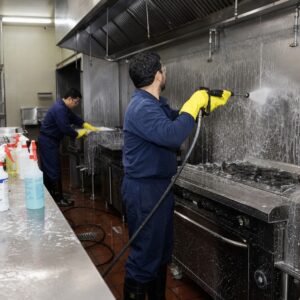
Institutional kitchens — the ones feeding students, patients, inmates, and residents day after day — operate under a different set of pressures than a typical restaurant. Volume is relentless, schedules are fixed around class periods or shift changes, budgets are tightly controlled by public funding, and the population being served is often more vulnerable to foodborne illness. Get cleaning wrong in a school cafeteria or long-term care dining hall, and the consequences go well beyond a bad health inspection score.
This guide covers what makes institutional kitchen cleaning different from standard commercial kitchen cleaning, the regulatory framework that governs schools, universities, correctional facilities, and residential institutions in Ontario, and the cleaning schedule that keeps these high-volume kitchens compliant and safe.
Why Institutional Kitchens Need a Different Cleaning Standard
Institutional foodservice covers a wide range of settings — K-12 school cafeterias, university dining halls, correctional facility kitchens, group homes, and residential care dining services. What they share is high, predictable volume served on a fixed schedule, a captive population with limited choice in where they eat, and public accountability that private restaurants don’t face in the same way.
Volume Without Flexibility
A restaurant can throttle covers on a slow night. A school cafeteria serving 800 students at lunch, or a correctional facility feeding three meals a day to a fixed population, cannot. Institutional kitchens run at consistent, high volume across every service, which means grease, food residue, and airborne contaminants accumulate on a predictable — and often faster — timeline than in a typical restaurant. Exhaust systems and hood filters that might get away with quarterly cleaning in a low-volume café need far more frequent attention in an institutional setting doing hundreds of covers daily.
Vulnerable Populations Raise the Stakes
Students, hospital patients, seniors in long-term care, and incarcerated individuals are often more susceptible to the consequences of poor food safety than the general public. Immune-compromised patients, young children, and elderly residents face higher risk from cross-contamination or pest activity linked to grease and food debris buildup. This is a core reason institutional kitchens are subject to more frequent inspection and stricter documentation requirements than most private restaurants.
Public Accountability and Funding Scrutiny
Institutional kitchens are usually publicly funded or operate under a public mandate — school boards, municipal correctional services, hospital networks, and government-run care facilities. That funding comes with reporting obligations. A failed health inspection or a fire code violation at a public institution tends to draw more scrutiny (and more media attention) than the same issue at a standalone restaurant, making proactive compliance a reputational as well as an operational priority.
Regulatory Framework for Institutional Kitchens in Ontario
Institutional kitchens in Ontario are governed by an overlapping set of provincial health, fire, and sector-specific regulations.
Ontario Food Premises Regulation (O. Reg. 493/17)
All food premises in Ontario, including institutional kitchens, fall under O. Reg. 493/17, which sets baseline requirements for sanitation, pest control, and safe food handling. Public health inspectors conduct routine inspections of school cafeterias, correctional kitchens, and care facility dining services, and grease buildup on hoods, filters, and behind equipment is a common citation.
NFPA 96 and the Ontario Fire Code
Exhaust system cleaning frequency for institutional kitchens is governed by NFPA 96, which sets minimum cleaning intervals based on cooking volume — and most institutional kitchens fall into the “high-volume” category requiring quarterly professional cleaning, not the twice-a-year schedule common in lower-volume operations. The Ontario Fire Code adopts NFPA 96 by reference, meaning fire inspectors will check cleaning certificates and service tags on ductwork during routine walkthroughs. For school boards and correctional facilities, a documented, defensible cleaning history isn’t optional — it’s the evidence that satisfies both public health and fire officials during audits.
Sector-Specific Oversight
Depending on the institution type, additional layers of oversight apply. School board food services may be reviewed as part of broader facility safety audits. Correctional facility kitchens fall under the Ministry of the Solicitor General’s operational standards. Long-term care and retirement home dining services are subject to the Fixing Long-Term Care Act and related inspection protocols, which treat foodservice sanitation as a component of overall resident safety. Each of these layers ultimately points back to the same operational requirement: clean exhaust systems, clean equipment, and clean documentation.
The Institutional Kitchen Cleaning Schedule
Because institutional kitchens run at consistent high volume, a layered cleaning schedule — daily, weekly, and professional — is essential to stay ahead of grease accumulation and inspection risk.
Daily Cleaning Tasks
Kitchen staff should handle surface-level cleaning after every meal service: wiping down prep surfaces and cooking equipment, cleaning hood filters (removable baffle filters can often be degreased in a dish machine or dedicated soak tank), sweeping and mopping floors, and emptying grease traps or interceptors on higher-volume lines. In institutional settings with fixed meal windows, building this into the standard closing checklist between service periods is critical — there’s often less downtime than in a restaurant to catch up on missed tasks.
Weekly and Monthly Deep Cleaning
Beyond daily upkeep, institutional kitchens should schedule weekly deep cleaning of walk-in coolers, dish pits, and storage areas, and monthly attention to hard-to-reach zones — behind and under heavy equipment, walk-in fan coils, and floor drains. Given the fixed population these kitchens serve, pest control inspections should be paired with these deep cleans, since grease and food debris buildup is one of the most common attractants for pest activity in institutional settings.
Professional Exhaust System Cleaning
Given high-volume classification under NFPA 96, most institutional kitchens require professional exhaust system cleaning on a quarterly basis, cleaned to bare metal with before-and-after documentation and a certificate for the compliance file. This documentation matters more in institutional settings than almost anywhere else — school boards and correctional facilities are frequently required to produce cleaning records during facility audits, insurance reviews, or after any fire-related incident, however minor.
Common Compliance Gaps in Institutional Kitchens
A few recurring issues show up across school, correctional, and care-facility kitchens during inspections and audits.
Inconsistent Documentation Across Multiple Sites
School boards and correctional systems often operate multiple kitchen locations under one administrative umbrella. Cleaning frequency and documentation quality frequently vary site to site when each location manages its own vendor relationships. Centralizing exhaust cleaning and hood cleaning under a single provider with consistent reporting makes multi-site compliance dramatically easier to manage and audit.
Underestimating True Cooking Volume
Kitchens that only run breakfast and lunch sometimes get classified as lower-volume than their actual grease output justifies, especially when the menu skews toward fried or high-fat items. An honest volume assessment — not just service hours — should drive cleaning frequency decisions.
Deferred Maintenance Due to Budget Cycles
Public institutions often work within fixed annual budgets, which can push non-urgent maintenance like exhaust cleaning to “next fiscal year” when funds run tight. This is a false economy: deferred grease cleaning increases fire risk and often results in far more expensive emergency remediation, plus potential facility shutdown, when a fire marshal flags the issue during an unannounced inspection.
Frequently Asked Questions
How often does a school cafeteria kitchen need professional exhaust cleaning?
Most school cafeterias fall into the moderate-to-high volume category under NFPA 96, requiring professional exhaust and hood cleaning every three to four months depending on how much frying and grilling the menu includes. A cleaning provider can assess your specific volume and set the right interval.
Are correctional facility kitchens held to the same fire code standards as restaurants?
Yes. The Ontario Fire Code applies to any commercial kitchen regardless of the type of facility, and correctional kitchens — often running three meals a day for a fixed population — typically qualify as high-volume, high-frequency cleaning operations under NFPA 96.
Who is responsible for cleaning compliance at a multi-site school board?
Ultimately the school board or facility owner is responsible for compliance at each site, even when day-to-day cleaning is delegated to on-site staff or an outside vendor. Centralizing exhaust and hood cleaning across all sites with one accountable provider makes it far easier to maintain consistent documentation for audits.
Can institutional kitchens use the same cleaning schedule as a restaurant?
Not usually. Institutional kitchens typically run higher, more consistent volume across fixed service windows, which often pushes them into a more frequent professional cleaning tier than a comparable restaurant with variable traffic and off-peak downtime.
What documentation should institutional kitchens keep on file?
At minimum: dated cleaning certificates from every professional exhaust and hood cleaning service, before-and-after photos, and a log of daily and weekly in-house cleaning tasks. This documentation is what satisfies public health inspectors, fire marshals, and internal or ministry audits.
Keep Your Institutional Kitchen Compliant and Safe
Whether you’re managing a single school cafeteria or coordinating cleaning across a multi-site school board, correctional network, or care facility group, AquaForce Power Clean has spent over 26 years serving institutional and commercial kitchens across the GTA and Southern Ontario — including major venues like Pearson Airport and MLSE’s Scotiabank Arena. We understand the documentation, frequency, and compliance demands institutional clients face, and we’re fully WSIB covered and NFPA 96 compliant on every job.
Explore our full range of commercial kitchen cleaning services or learn more about our hood cleaning process. Ready to get your institutional kitchen on a compliant cleaning schedule? Request a quote today.