Healthcare Kitchen Cleaning: Standards, Requirements & Best Practices for Hospital Foodservice Facilities
When it comes to commercial kitchen cleaning, few environments carry higher stakes than a hospital or healthcare facility kitchen. Patients recovering from surgery, chemotherapy, or serious illness have compromised immune systems — meaning a single lapse in food safety or sanitation can trigger infections with life-altering consequences. Professional healthcare kitchen cleaning is not just about compliance; it is a frontline patient safety measure. In this guide, we break down the standards, cleaning requirements, and best practices that govern kitchen sanitation in hospitals, long-term care homes, and other healthcare settings across Ontario.
Why Healthcare Kitchen Cleaning Is Different From Other Commercial Kitchens
A restaurant kitchen must meet provincial health codes. A hospital kitchen must meet those plus a layered set of infection control protocols, Ministry of Health guidelines, and facility-specific standards set by accreditation bodies. The consequences of non-compliance are also different — in a healthcare setting, an outbreak of Listeria, Salmonella, or C. difficile linked to food services can trigger a facility-wide shutdown, regulatory investigation, and — most importantly — patient harm.
Key Differences From Restaurant Kitchens
- Vulnerable populations: Patients include immunocompromised, elderly, post-surgical, and critically ill individuals.
- Stricter pathogen thresholds: Cross-contamination risk windows are narrower; cleaning standards are more stringent.
- Accreditation requirements: Accreditation Canada and Ontario’s Ministry of Long-Term Care mandate specific cleaning protocols and documentation.
- Continuous operation: Many hospital kitchens run 18–24 hours per day, leaving shorter cleaning windows.
- Audit and documentation requirements: Cleaning logs, chemical usage records, and third-party service reports are required and reviewed during inspections.
Regulatory Standards Governing Hospital Kitchen Cleaning in Ontario
Healthcare kitchen operators in Ontario must navigate several overlapping regulatory frameworks. Understanding these is essential before designing a cleaning program.
Ontario Food Premises Regulation (O. Reg. 493/17)
All food-handling premises in Ontario — including hospital kitchens — must comply with O. Reg. 493/17 under the Health Protection and Promotion Act. This includes requirements for surface sanitation, dishwashing water temperatures, waste management, pest control, and equipment maintenance. Public health inspectors can conduct unannounced inspections at any time.
Accreditation Canada Qmentum Standards
Most acute care and long-term care facilities in Ontario seek or maintain Accreditation Canada status. Qmentum standards include service excellence criteria for food services, which cover staff training, cleaning documentation, infection control integration, and hazard analysis. Non-compliance can result in conditional status or loss of accreditation.
Ontario Long-Term Care Homes Act, 2007
Long-term care homes face some of the strictest food service standards in the province. The Act and its regulations specify cleaning frequencies for kitchen equipment, pest control measures, temperature monitoring, and staff hygiene. The Ministry of Long-Term Care conducts annual and complaint-driven inspections.
NFPA 96: Ventilation Control and Fire Protection
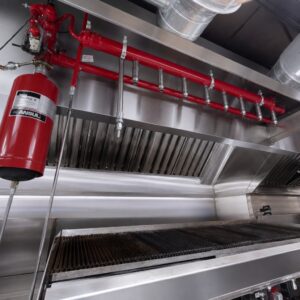
Healthcare kitchens are subject to NFPA 96, just like any other commercial kitchen. This standard governs exhaust hood cleaning frequency, grease accumulation limits, and fire suppression system maintenance. Hospital kitchens that cook at high volumes may qualify for more frequent cleaning intervals (quarterly rather than semi-annual). Failure to comply creates fire risk and voids insurance coverage — both significant concerns in a healthcare environment. AquaForce provides NFPA 96-compliant exhaust cleaning for healthcare facilities across the GTA.
The Core Components of a Healthcare Kitchen Cleaning Program
A compliant and effective healthcare kitchen cleaning program operates across three time horizons: daily, periodic, and deep-clean cycles.
Daily Cleaning Protocols
Daily cleaning tasks in a healthcare kitchen must be documented and signed off by a supervising staff member. Core daily tasks include:
- Sanitizing all food-contact surfaces (cutting boards, prep tables, slicers, mixers) after each use
- Cleaning and sanitizing sinks, dishwashing areas, and dish staging zones
- Sweeping and mopping all floor areas, including under equipment where possible
- Cleaning grease traps and floor drains to prevent build-up and odour
- Wiping down refrigeration and freezer door seals and handles
- Cleaning ovens, steamers, combi-ovens, and fryers at the end of service
- Replacing sanitizer solutions in three-compartment sinks and wiping cloths
- Removing and bagging all waste, cleaning waste receptacles with disinfectant
Weekly and Monthly Cleaning Tasks
Beyond daily sanitation, healthcare kitchens require scheduled deep-cleaning tasks on a weekly or monthly basis:
- Detailed cleaning of walk-in coolers and freezers (walls, floors, shelving, door gaskets)
- Descaling and cleaning of steam tables, braising pans, and tilt skillets
- Cleaning inside and behind refrigeration units — coil cleaning to maintain efficiency
- Deep scrubbing of grout lines and floor-to-wall junctions where bacteria accumulate
- Full disassembly and cleaning of slicers, can openers, and other high-contact equipment
- Inspection and cleaning of fire suppression system nozzle covers over cooking equipment
- Washing of all ceiling tiles, exhaust vents, and overhead surfaces in food preparation areas
Scheduled Deep Cleaning and Professional Services
In addition to in-house cleaning, healthcare kitchen operators should schedule professional deep cleaning services at regular intervals. This includes:
- Exhaust hood and duct cleaning: Quarterly or semi-annually, depending on cooking volume. Required under NFPA 96.
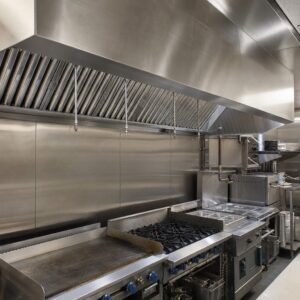
- Full kitchen degrease: A professional-grade degreasing of all cooking equipment, floors, walls, and ceilings behind and beneath equipment — not achievable with in-house staff.
- Tile and grout restoration: Power washing and restorative cleaning of kitchen floors to eliminate embedded grease and bacterial biofilm.
- Equipment pull-out cleaning: Moving all major equipment to clean beneath and behind it — an area consistently flagged in health inspections as a source of pest activity and grease accumulation.
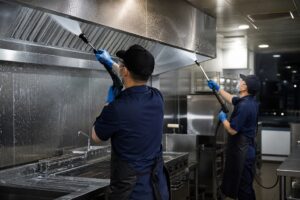
AquaForce Power Clean provides comprehensive commercial kitchen cleaning services for healthcare facilities, including hospital and long-term care kitchens, across Ontario. Our teams are trained in infection control requirements and can work within the restricted windows typical of 24-hour food service operations.
Infection Control Considerations in Healthcare Kitchen Cleaning
Infection control is where healthcare kitchen cleaning diverges most sharply from restaurant protocols. Kitchen managers should be aligned with the facility’s Infection Prevention and Control (IPAC) team on the following:
Chemical Selection and Compatibility
Cleaning chemicals used in healthcare kitchens must be compatible with the facility’s broader infection control program. Quaternary ammonium compounds (quats) are common kitchen sanitizers, but their efficacy against C. difficile spores is limited — bleach-based solutions may be required in specific circumstances. Always follow Public Health Ontario guidance on chemical selection for healthcare environments.
Preventing Cross-Contamination
Healthcare kitchens serving specialized diets (allergen-free, texture-modified, oncology diet) must maintain strict cross-contamination controls. Colour-coded equipment, dedicated prep zones, and cleaning protocols for allergen areas are all standard practice.
Staff Hygiene and PPE
Kitchen staff and external cleaning crews working in healthcare facilities are often required to follow the facility’s hand hygiene protocols, including the use of alcohol-based hand rub at critical moments. When professional cleaners are brought in, facility IPAC requirements regarding PPE and access protocols should be communicated in advance.
Common Inspection Failures in Healthcare Kitchen Audits
If your facility is preparing for a Ministry of Long-Term Care inspection or a public health visit, these are the most frequently cited non-conformances in healthcare kitchen audits:
- Grease accumulation on exhaust hoods and filters — still the leading fire and sanitation finding
- Incomplete or absent cleaning logs — documentation is as important as the cleaning itself
- Food-contact surfaces with residue — particularly slicers and can openers
- Walk-in cooler temperature non-compliance — often linked to poor door seal maintenance and coil cleaning neglect
- Pest evidence beneath and behind equipment — directly related to how infrequently equipment is moved for cleaning
- Improper sanitizer concentration — too weak or too strong, both creating compliance issues
- Floor drain build-up and odours — a consistent finding in high-volume kitchens
AquaForce and Healthcare Facility Cleaning
AquaForce Power Clean has over 26 years of experience serving commercial kitchens across Southern Ontario, including healthcare and institutional facilities. Our work in healthcare environments reflects the demands of the sector: scheduled access, documentation of work completed, NFPA 96-compliant exhaust cleaning, and cleaning teams experienced in working within infection control frameworks.
We serve hospitals, long-term care homes, retirement residences, rehabilitation centres, and other healthcare facilities throughout the GTA and Southern Ontario — from Toronto and Mississauga to Hamilton, Vaughan, and beyond. Our clients include some of Canada’s highest-profile foodservice operations, and we bring the same rigour to every healthcare kitchen we service.
If your facility is due for a professional kitchen deep clean, an exhaust system inspection, or a full NFPA 96 cleaning service, contact AquaForce for a quote. We work around your schedule to minimize disruption to food service operations.
Frequently Asked Questions: Healthcare Kitchen Cleaning
How often should a hospital kitchen exhaust hood be cleaned?
Under NFPA 96, exhaust hoods in high-volume cooking environments — which most hospital kitchens qualify as — should be cleaned quarterly. Lower-volume healthcare kitchens (such as in smaller long-term care homes) may qualify for semi-annual cleaning. Your exhaust cleaning provider should assess cooking type and volume and recommend the appropriate interval.
Are outside cleaning contractors allowed in healthcare facility kitchens?
Yes, and in most cases they are necessary to meet deep-cleaning requirements that in-house staff cannot achieve with standard equipment. Contractors should be vetted for commercial kitchen experience, provided with the facility’s IPAC requirements in advance, and asked to supply documentation of services performed (including cleaning logs and photos for exhaust cleaning).
What chemicals are appropriate for sanitizing food contact surfaces in a hospital kitchen?
Health Canada–approved sanitizers with proven efficacy against the pathogens of concern in your environment. Quaternary ammonium compounds are standard for most surfaces, but facilities with C. difficile concerns should use chlorine-based sanitizers at appropriate concentrations. Always consult your IPAC team when selecting sanitizers for food service areas.
What documentation should a healthcare kitchen keep for cleaning activities?
At minimum: daily cleaning logs signed by responsible staff, temperature logs for refrigeration and hot-holding, dishwasher water temperature logs, sanitizer concentration check records, pest control service reports, and third-party cleaning service reports (including exhaust cleaning certificates). These are reviewed during Ministry inspections and accreditation surveys.
Can AquaForce work overnight or on off-hours in a healthcare kitchen?
Yes. AquaForce routinely works in environments with restricted access windows, including overnight and weekend shifts. We coordinate with your facility management and food services team to schedule work that minimizes any disruption to food service or patient care operations.
Conclusion: Professional Cleaning Is a Patient Safety Investment
Healthcare kitchen cleaning is a non-negotiable part of infection control, regulatory compliance, and operational risk management. In a facility where patients depend on safe food service as part of their recovery, the standard cannot be “good enough” — it must be verified, documented, and maintained consistently. Professional deep cleaning services, combined with a strong in-house daily protocol, are the foundation of a compliant and safe healthcare kitchen.
AquaForce Power Clean specializes in high-standard commercial kitchen cleaning for healthcare and institutional facilities across Ontario. Whether you need NFPA 96-compliant exhaust system cleaning, a full kitchen degrease, or an ongoing service schedule, our team is equipped to meet your facility’s requirements. Request a quote today and find out why Ontario’s leading healthcare operators trust AquaForce to keep their kitchens clean, compliant, and safe.